Introduction
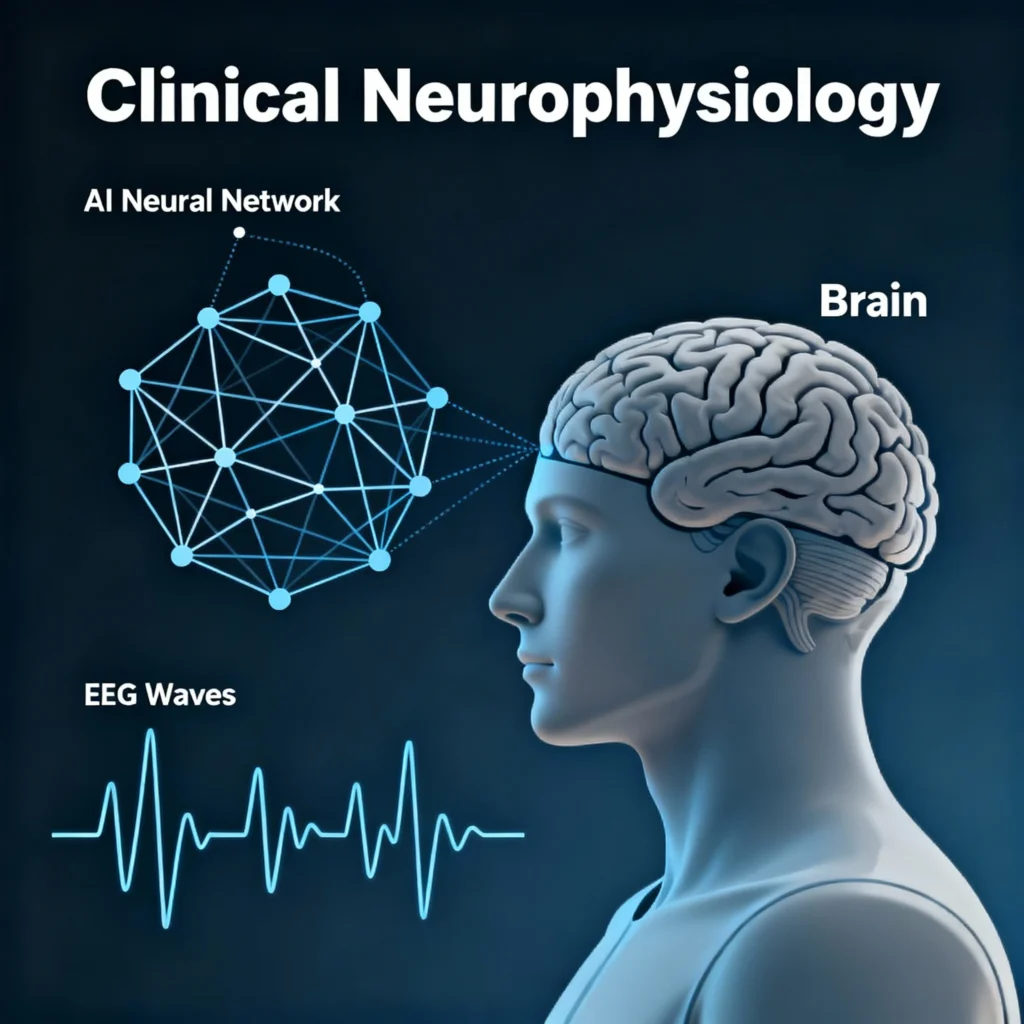
Artificial Intelligence in Clinical Neurophysiology is fundamentally transforming the field, revolutionizing how neurologists and clinical neurophysiologists interpret electroencephalography (EEG), electromyography (EMG), nerve conduction studies (NCS), and neuroimaging data. The integration of machine learning (ML) and deep learning algorithms has evolved from experimental research to practical clinical applications, with AI systems now achieving diagnostic accuracy that rivals—and sometimes surpasses—human experts. As the discipline faces increasing data volumes, interrater variability, and workforce shortages, AI is emerging as an indispensable co-pilot, enhancing clinical decision-making, diagnostic precision, and efficiency.
Key Insights
-
Artificial intelligence is transforming how we interpret EEG, EMG, and neuroimaging data.
-
Deep learning models now outperform traditional analysis in several neurodiagnostic domains.
-
Integration of AI tools can enhance diagnostic accuracy and workflow efficiency in neurophysiology labs.
Challenges in Conventional Neurodiagnostic Interpretation
Traditional neurodiagnostic interpretation remains labor-intensive and subject to significant limitations. EEG analysis requires expert neurophysiologists to manually review hours of continuous recordings, a process vulnerable to fatigue-induced errors and inter-rater disagreement rates approaching 20-30% for complex waveforms. EMG interpretation depends heavily on the examiner’s experience and clinical context, with limited standardization across laboratories. Neuroimaging analysis, particularly in acute stroke settings where minutes determine outcomes, can be delayed by radiologist availability and human oversight of subtle ischemic changes. These bottlenecks necessitate automated, objective, and reproducible analytical tools capable of processing multimodal data in real time while maintaining clinical accuracy.
AI-Driven EEG Analysis: Recent Models and Performance Metrics
AI applications in EEG have matured substantially between 2023 and 2025, with deep learning architectures achieving remarkable performance in epilepsy detection and seizure prediction. Convolutional neural networks (CNNs) combined with long short-term memory (LSTM) networks now automatically identify interictal epileptiform discharges with sensitivities exceeding 97% and specificities above 96%, with false detection rates as low as 0.487 per hour on validated datasets such as CHB-MIT and Bonn. The SCORE-AI system, trained on over 30,000 multicenter EEG recordings, successfully discriminates normal from abnormal EEG with accuracy comparable to experienced neurophysiologists. Short-time Fourier transform (STFT) combined with GoogleNet CNN architectures process 6-channel scalp EEG in real time, achieving 97.74% accuracy in epilepsy detection. Predictive AI models utilizing LSTM networks analyze temporal and frequency-domain features to forecast seizures with sensitivities exceeding 95%, enabling proactive intervention rather than reactive management. These systems represent a paradigm shift from supportive to predictive AI, transitioning epilepsy care from postdiagnosis treatment to real-time prediction and prevention.
Summary:
AI-based EEG algorithms can detect subtle abnormalities that might be overlooked in routine visual interpretation, improving both accuracy and speed.
AI in EMG and Nerve Conduction Studies: Neuromuscular Disease Classification
EMG and NCS interpretation has similarly benefited from AI integration, particularly in classifying neuromuscular disorders such as amyotrophic lateral sclerosis (ALS), myopathies, and peripheral neuropathies. Bidirectional LSTM (Bi-LSTM) networks optimized using Grey Wolf Optimizer (GWO) algorithms achieve classification accuracies of 95%, with precision of 93% and recall of 91% across diverse neuromuscular conditions. Machine learning algorithms including support vector machines (SVM), random forests, and deep learning models automate feature extraction from EMG signals, reducing dependency on manual waveform analysis and improving diagnostic consistency. AI-enhanced EMG systems excel in motor unit abnormality detection and signal denoising, though challenges persist due to limited publicly available datasets and the critical importance of integrating clinical context with electrophysiological findings. Ongoing research focuses on expanding training datasets and developing models capable of incorporating patient history, comorbidities, and examination findings to improve diagnostic specificity.
AI in Neuroimaging: Stroke Detection and Neurodegeneration
AI’s impact on neuroimaging analysis is particularly pronounced in acute stroke management and neurodegenerative disease detection. Deep learning models analyze CT and MRI scans within seconds, identifying large vessel occlusions (LVOs) and reducing door-to-needle times by up to 18 minutes—a critical advantage given the narrow therapeutic window for thrombolysis. Meta-analyses demonstrate that AI systems achieve pooled sensitivities of 86.9% and specificities of 88.6% for ischemic stroke, and even higher performance for hemorrhagic stroke (sensitivity 90.6%, specificity 93.9%), approaching the diagnostic accuracy of expert neuroradiologists. FDA-cleared AI platforms including RapidAI, Brainomix 360, and Viz ICH Plus are now deployed in emergency departments worldwide, facilitating rapid triage and treatment decisions. In neurodegenerative diseases, AI algorithms trained on structural MRI detect cortical atrophy patterns and predict cognitive decline with 85% accuracy in Alzheimer’s disease, enabling earlier intervention. The FDA clearance of Cirrus Resting State fMRI Software in 2025 exemplifies AI’s expanding role in functional brain mapping for neurosurgical planning.
Multimodal Integration: Combining Electrophysiology, Imaging, and Clinical Data
The frontier of AI in clinical neurophysiology lies in multimodal data integration, synthesizing structural MRI, functional connectivity from fMRI, electrophysiological signals, genomic data, and clinical variables into unified diagnostic models. Hybrid deep learning frameworks combining CNNs for spatial feature extraction from neuroimaging with gated recurrent units (GRUs) for temporal pattern analysis from EEG/fMRI achieve classification accuracies exceeding 96% in neurological disorder identification. Dynamic cross-modality attention mechanisms prioritize diagnostically relevant features across modalities, enhancing model interpretability—a critical requirement for clinical adoption. Early fusion, joint fusion, and late fusion strategies enable AI systems to leverage complementary information streams, improving diagnostic confidence and enabling personalized treatment planning. Wearable neurodiagnostic devices integrated with AI now provide continuous multimodal monitoring of gait patterns, tremor, physiological signals, and cognitive performance, facilitating remote neurological assessment and early detection of symptom progression in Parkinson’s disease and other movement disorders.
Ethical, Regulatory, and Data Privacy Considerations
The clinical deployment of AI in neurophysiology necessitates rigorous attention to ethical and regulatory frameworks. The European Union’s AI Act, which entered into force in August 2024, classifies AI-enabled medical devices as high-risk systems requiring comprehensive risk mitigation, high-quality training datasets, transparency in algorithmic decision-making, and mandatory human oversight. Manufacturers must address algorithmic bias, model drift, and fundamental rights considerations including privacy and non-discrimination. In the United States, HIPAA compliance remains paramount, requiring end-to-end encryption of protected health information (PHI), de-identification protocols, and business associate agreements with AI vendors. The FDA has authorized over 690 AI/ML-enabled medical devices as of 2024, with ongoing emphasis on post-market surveillance and adaptive regulation to match the rapid evolution of AI technologies. Explainable AI (XAI) methodologies are increasingly prioritized to build clinician trust and enable effective oversight of AI-driven recommendations.
Case Studies and Real-World Applications
Real-world implementations demonstrate AI’s clinical utility across neurophysiology subspecialties. FDA-cleared automated seizure detection systems such as BrainWatch and Zeto EEG devices enable continuous monitoring in intensive care and epilepsy monitoring units, alerting clinicians to seizure activity within seconds. Point-of-care EEG systems augmented with AI algorithms facilitate urgent neurological assessments in resource-limited settings, achieving 85% diagnostic agreement with expert interpretations. AI-powered stroke imaging platforms have been deployed in over 1,500 hospitals globally, demonstrating measurable improvements in treatment times and patient outcomes including 20% reductions in post-stroke disability. Adaptive deep brain stimulation systems utilize real-time AI analysis of local field potentials to personalize therapeutic stimulation in Parkinson’s disease, optimizing symptom control while minimizing side effects.
Future Directions: Wearable Diagnostics, Real-Time Analysis, and Tele-Neurophysiology
The future of AI in clinical neurophysiology encompasses several transformative directions. Wearable neurodiagnostic devices incorporating flexible electronics, biosensors, and AI-enabled analysis will enable continuous ambulatory monitoring, shifting care from episodic clinic visits to longitudinal real-time assessment. Federated learning architectures will allow AI model training across multiple institutions while preserving patient privacy, addressing data scarcity and improving generalizability. Tele-neurophysiology platforms integrating AI interpretation will expand access to specialist expertise in underserved regions, democratizing high-quality neurodiagnostic care. Generative AI and foundation models may eventually synthesize patient history, multimodal test results, and medical literature to generate comprehensive diagnostic and treatment recommendations, though rigorous validation and regulatory frameworks remain essential prerequisites.
Key Takeaways
-
AI in clinical neurophysiology has transitioned from research to clinical deployment, with systems achieving expert-level diagnostic accuracy in EEG, EMG, and neuroimaging analysis
-
Deep learning models demonstrate sensitivities and specificities exceeding 90% in epilepsy detection, neuromuscular disorder classification, and acute stroke identification
-
Multimodal AI integration combining electrophysiology, neuroimaging, and clinical data represents the next frontier in personalized neurology
-
Regulatory frameworks including the EU AI Act and FDA oversight ensure safety, transparency, and ethical deployment of AI-enabled medical devices
-
Future directions emphasize wearable diagnostics, real-time monitoring, and tele-neurophysiology to democratize specialist expertise
Conclusion
Artificial intelligence is redefining clinical neurophysiology by augmenting—not replacing—human expertise with powerful analytical capabilities that enhance diagnostic precision, efficiency, and accessibility. As AI technologies mature and regulatory frameworks evolve, the neurophysiology community must embrace responsible innovation, prioritizing patient safety, algorithmic transparency, and equitable access. NeuroMed Hub remains committed to advancing neurodiagnostic education and fostering informed adoption of AI innovations that empower clinicians and improve patient outcomes in this transformative era of neuroscience.