Introduction: When “Normal” Doesn’t Feel Good
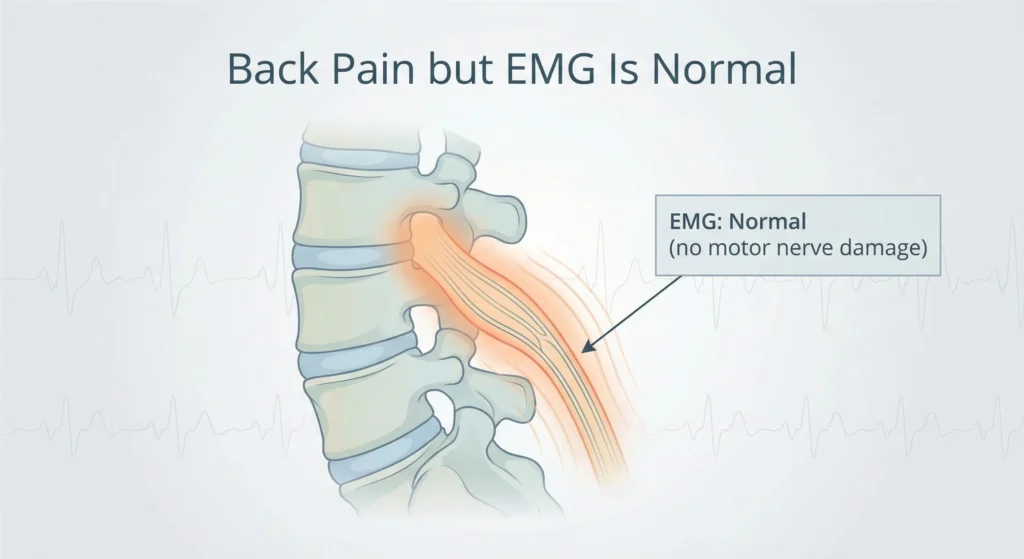
Receiving a “normal” test result is usually a moment of relief. But if you are suffering from chronic back pain or shooting leg pain, being told your EMG (Electromyography) is normal can feel confusing, frustrating, or even invalidating. You might find yourself asking: If the test is normal, why do I still hurt? Is it all in my head?
At NeuroMedHub, we want you to know one thing immediately: A normal EMG does not mean you are imagining your pain.
It simply means the specific type of nerve damage the test looks for isn’t present right now. This article explains why EMG normal but back pain persists, what the test might have missed, and why this result is actually a positive step in your diagnosis.
What EMG Actually Detects (And What It Doesn’t)
To understand your results, you have to understand the tool. Many patients believe an EMG is like an MRI—a picture of your back. It isn’t.
Think of an MRI as a photograph of a highway, showing if there is a traffic jam (a herniated disc). An EMG is like a traffic report; it tells you if the cars (electrical signals) are actually moving.
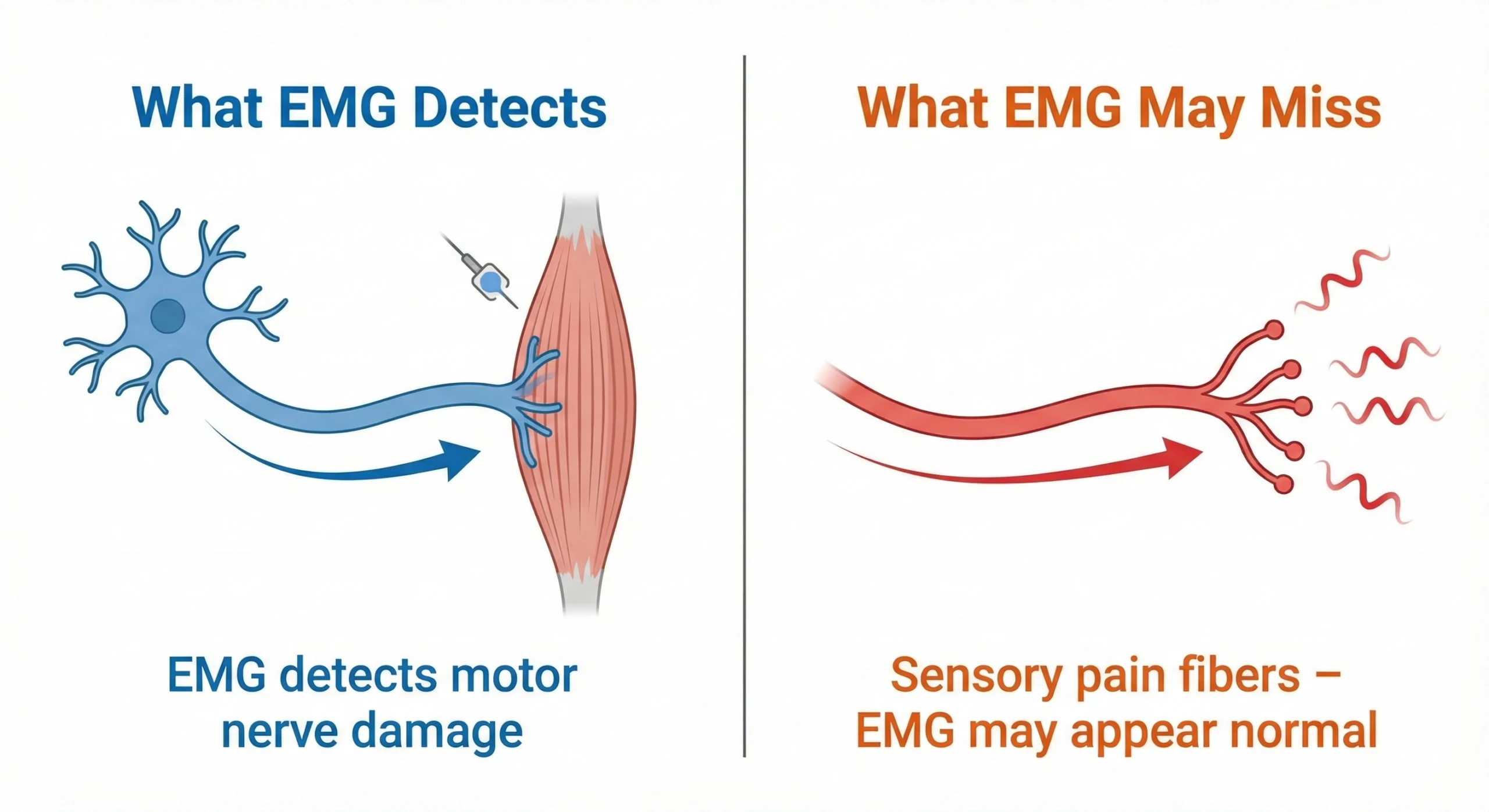
What EMG Detects:
Axonal Loss: Severe damage where the inner wire of the nerve is broken.
Motor Nerve Damage: Issues with the nerves that control muscle movement.
Old vs. New Damage: It can tell if a nerve injury is fresh or chronic.
What EMG Often Misses:
Pure Sensory Pain: If the compression only affects the sensory fibers (the ones that feel pain) but not the motor fibers (the ones that move muscles), the needle EMG will often look normal.
Structural Problems: It cannot see arthritis, muscle tears, or ligament strain.
What Patients Usually Misunderstand About EMG
The biggest misconception is that EMG measures pain. It does not. It measures function. You can have severe, debilitating pain from a pinched nerve, but if the nerve is still conducting electricity to the muscle effectively, your EMG may come back “normal.”
Can EMG Miss Nerve Compression?
The short answer is: Yes.
This is one of the most common questions in our clinic: Can EMG miss nerve compression? It is entirely possible to have radicular pain with normal EMG results. In medical terms, this is often called a “clinical radiculopathy without electrodiagnostic confirmation.”
Here is why the test might miss it:
Timing (Too Early): If you developed back pain only a week ago, it is likely too early for the EMG to pick it up. Nerves take 14 to 21 days to show signs of damage (denervation) after being compressed.
Intermittent Compression: If your nerve is only pinched when you stand or walk, but you are lying down during the test, the nerve might be functioning happily during the exam.
Pain Without Axonal Loss: You can have a “stunned” nerve (neurapraxia) that hurts incredibly bad but hasn’t actually died back or lost fibers. This is actually a good prognosis!
Clinical Note: Studies suggest that EMG has a sensitivity of roughly 50-70% for radiculopathy. That means in a significant number of cases, a patient has a pinched nerve, but the electrical study appears normal.
Common Causes of Back Pain with Normal EMG
If the nerves aren’t showing damage, where is the pain coming from? Here are the most common culprits when we see EMG normal but back pain persists.
1. Musculoskeletal & Myofascial Pain
The most common cause of back pain isn’t the nerves—it’s the machinery around them. Muscle spasms, trigger points, and myofascial pain syndrome can mimic nerve pain but will always produce a normal EMG.
2. Facet Joint Syndrome
Your spine has small joints called facet joints that help you twist and bend. If these become arthritic or inflamed, they can cause referred pain down the leg that feels exactly like sciatica, yet the nerves remain healthy.
3. Small Fiber Neuropathy
Standard EMGs test “large fibers” (movement and touch). They do not test “small fibers” (temperature and pain). Disorders affecting these tiny nerve endings can cause burning pain while the standard test looks perfect.
4. Central Sensitization
Sometimes, the volume knob in the brain gets turned up. The nerves are sending normal signals, but the brain interprets them as dangerous or painful. This is common in chronic pain conditions like fibromyalgia.
Fast Answers: “What Does This Mean For Me?”
For the patient in a hurry.
Does a normal EMG rule out nerve pain? No. It only rules out severe motor nerve damage. You can still have nerve irritation.
Is a normal EMG good news? Yes! It means your nerves are not dying or permanently damaged.
Do I need surgery? Usually, a normal EMG suggests you are a good candidate for non-surgical treatments like physical therapy, as there is no urgent nerve death occurring.
Is Nerve Pain Still Possible? (The Clinical Angle)
Yes, absolutely. Doctors often differentiate between Radiculopathy (objective loss of function, like weakness) and Radicular Pain (shooting pain).
You can suffer from intense radicular pain with normal EMG. This often happens because the sensory fibers (which carry pain signals) are more sensitive to pressure than motor fibers. A disc herniation might be just big enough to irritate the pain fibers, causing agony, but not big enough to crush the motor fibers.
This highlights the limitations of EMG in back pain: it is a test of motor deficits, not sensory pain symptoms in the spine.