Introduction
If your doctor has recommended an Electromyography (EMG) test, you have likely already visited Google to ask the big question: “Is an EMG painful?”
It is completely normal to be anxious. The internet is full of conflicting stories and forums where people share their worst experiences. However, the reality of the test is often much different—and much more manageable—than what you read online.
As a neurophysiologist, I often see patients who come into my clinic terrified, only to leave saying, “Is that it? I worried for nothing.”
In this guide, I will walk you through exactly what the test feels like, distinguish the myths from the facts, and give you the single best tip to make your experience as comfortable as possible.
The Two Parts of the Test: Shocks vs. Needles
To understand the sensation, you first need to understand that “EMG” is usually a combination of two different tests performed in one session. Patients often confuse the two.
1. Nerve Conduction Studies (NCS)
This is the first part of the exam. It tests how fast your nerves send signals.
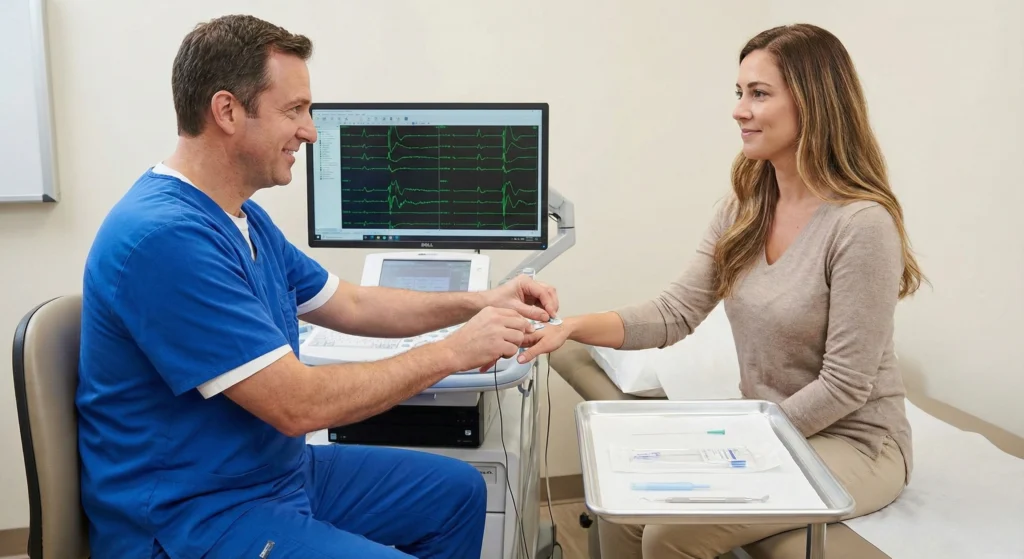
What happens: We place sticky patches (electrodes) on your skin and use a stimulator to send small electrical pulses to the nerve.
What it feels like: It feels like a sudden static shock—similar to when you walk on a carpet and touch a metal doorknob, or like a rubber band snapping against the skin.
The Verdict: It is surprising and can make your hand or foot twitch, but it is rarely described as “painful.” It is a strange sensation, but it is over in milliseconds.
2. The Needle Examination (EMG)
This is the second part, and usually the source of patient anxiety.
What happens: We use a very fine needle to test the electrical activity inside the muscle.
What it feels like: Most patients describe it as a small pinch or a mosquito bite. Once the needle is in place, you may feel a dull pressure, but sharp pain is uncommon.
The “Microphone” Analogy: Why It Hurts Less Than You Think
When patients hear the word “needle,” they immediately think of getting a vaccine or having blood drawn. This is the wrong comparison.
A hypodermic needle (for blood or vaccines) is hollow and has to be large enough for liquid to pass through. It creates a cutting sensation.
The EMG needle is different. It is:
Solid, not hollow.
Extremely thin (similar to an acupuncture needle).
Teflon-coated for smooth insertion.
Think of the EMG needle as a tiny microphone. We are not injecting medication, and we are not taking anything out of your body. We are simply placing a recording device into the muscle to “listen” to the electricity your body produces naturally. Because the needle is so fine, many patients don’t even feel it entering certain muscles.

The Secret to a Painless EMG: “The Wet Noodle”
Here is the most important advice I can give you as a specialist. The amount of discomfort you feel is almost entirely under your control.
The needle is designed to slide between muscle fibers. If you are relaxed, the needle slides in easily and painlessly.
However, if you are scared, you naturally tense your muscles. When you tense up, your muscle fibers bunch together tightly. If we try to insert the needle into a tight muscle, the muscle “grabs” the needle, which causes that cramping or pinching sensation.
The Trick: When the test begins, close your eyes, take a deep breath, and pretend your arm or leg is a “wet noodle” or “dead weight.” Let it go completely limp. If you can do this, the test will be 90% more comfortable.
Common Myths vs. Facts
There is a lot of misinformation about this procedure. Let’s clear it up.
Myth: The needle leaves permanent damage or scars. Fact: The needle is so small that the insertion point usually seals up instantly. You won’t even be able to find where the needle was five minutes later.
Myth: The test sends electricity through the needle. Fact: No. The needle is passive. It records electricity; it does not produce it. You will not get shocked by the needle.
Myth: I won’t be able to walk or drive afterward. Fact: You can return to your normal daily activities immediately. You can drive yourself home, type on a computer, or go for a walk right after the appointment.
Summary: Is it Worth It?
Is an EMG painful? It can be slightly uncomfortable, but it is generally well-tolerated. More importantly, it is the gold standard for diagnosing conditions like Carpal Tunnel Syndrome, pinched nerves, and neuropathy.
The detailed information we get from this test allows us to pinpoint exactly where your problem is so you can get the right treatment. A few minutes of discomfort is a small price to pay for a clear diagnosis and a path to recovery.