Epilepsy and seizure disorders remain one of the highest-yield topics on neurology board exams, including the USMLE Step 2 CK, the ABPN Neurology Boards, and residency in-service exams.
Mastering this section requires more than just memorizing drugs; you must be able to recognize specific clinical vignettes, identify classic EEG patterns, and make rapid management decisions for status epilepticus and pregnancy.
We have curated 10 high-yield questions that cover the most common “stumbling blocks” for residents and students. These questions test your ability to distinguish between similar syndromes (like JME vs. Absence) and recognize pathognomonic signs.
Instructions
Read each clinical vignette carefully.
Select the best answer.
Instant Feedback: The correct answer and a detailed explanation will appear immediately after you click.
Score Tracker: Your score is tallied automatically. At the end, you will see your final result.
Ready to test your knowledge?
Key Concepts Reviewed in This Quiz
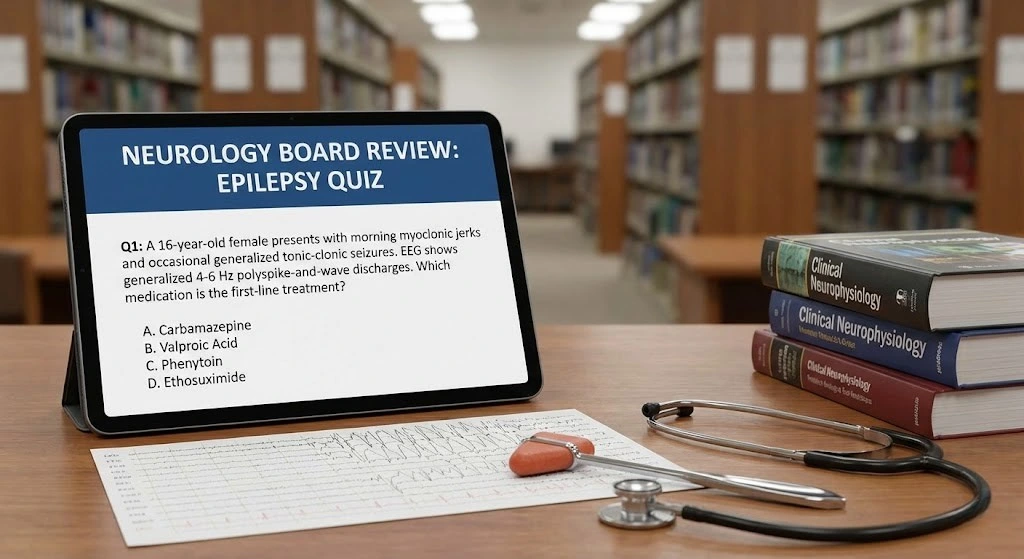
Juvenile Myoclonic Epilepsy (JME): Remember the triad of myoclonic jerks (morning), GTCs, and absence seizures. Valproic Acid is the broad-spectrum treatment of choice.
Absence Epilepsy: Look for the classic 3 Hz spike-and-wave on EEG. Hyperventilation is the potent trigger.
West Syndrome (Infantile Spasms): The triad is Spasms + Developmental Regression + Hypsarrhythmia on EEG.
Drug Side Effects: Stevens-Johnson Syndrome (SJS) is a life-threatening risk with Lamotrigine, especially if titrated too quickly.
Status Epilepticus Protocol: If benzodiazepines (Phase 1) fail, you must immediately move to Phase 2 agents like Fosphenytoin, Valproic Acid, or Levetiracetam.
Autoimmune Encephalitis: In young patients with psychiatric symptoms and seizures, always look for the “Extreme Delta Brush” pattern on EEG, which suggests Anti-NMDA Receptor Encephalitis. (See our full Case Report on Anti-NMDA Encephalitis here for a deeper dive).
Join the Discussion
How did you score? Did the question on “Extreme Delta Brush” catch you off guard?
Scroll down and leave a comment with your score (e.g., “8/10”)! Let’s see who is ready for Boards.