
Introduction
If you are searching online hoping to understand why your doctor ordered a nerve conduction study, you are not alone. Leaving an appointment with a referral slip for a test you’ve never heard of can be unsettling.
Why do you need this? Does it mean you have serious nerve damage?
It is normal to be worried when you don’t know what to expect. As a clinical neurophysiologist, I often see patients who arrive for their appointment confused about why they are even there. Their doctor recognized symptoms like numbness, tingling, or weakness, but they need my specialized testing to pinpoint the exact cause.
Think of your referring doctor as a detective who has found a clue. The NCS/EMG test is the magnifying glass they need to solve the case.
Here is a clear, non-technical explanation of exactly what we are looking for when we perform these tests.
The “Electrical Wiring” Analogy
To understand why you need this test, you have to think of your body like a house.
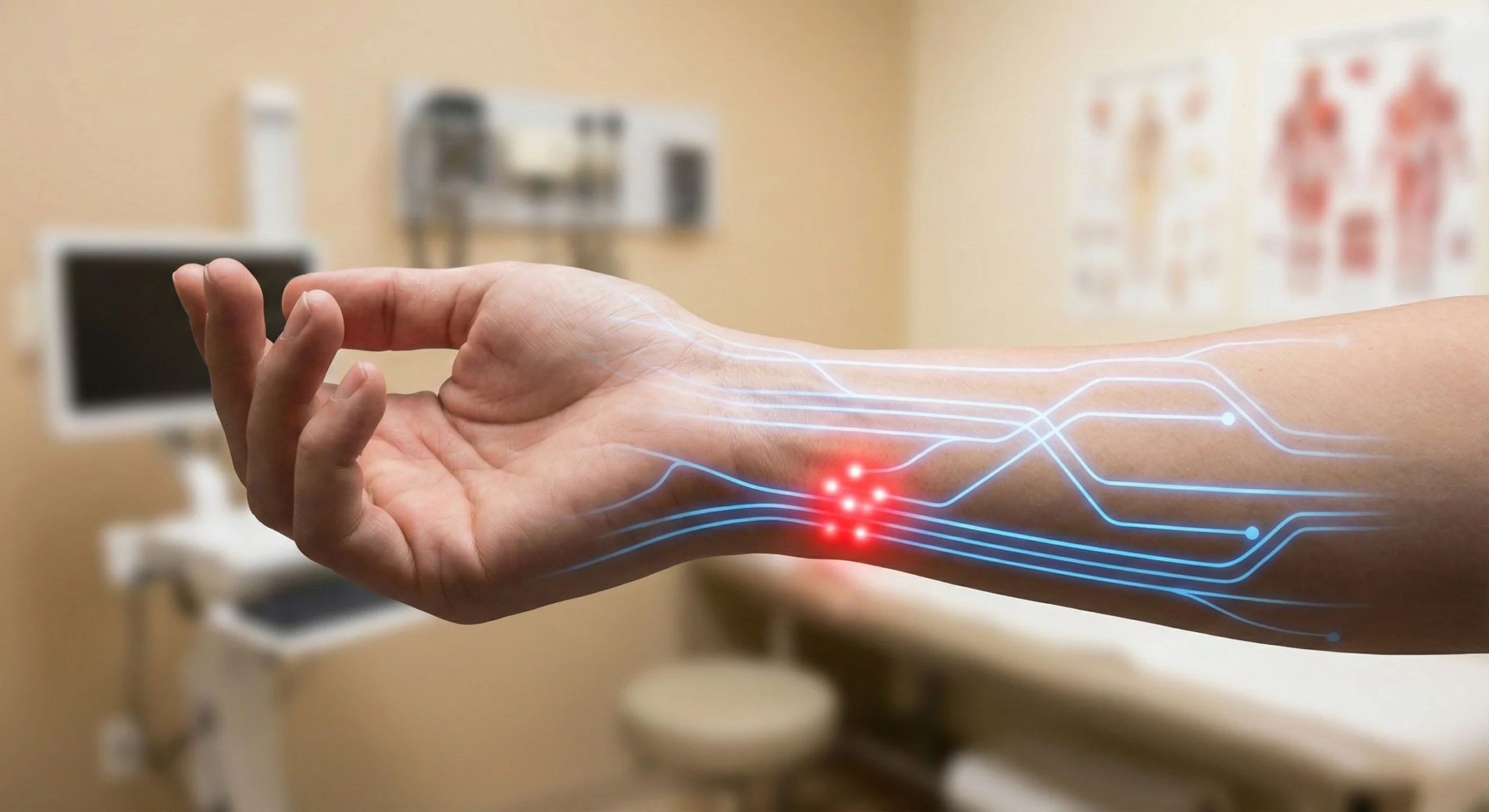
Your brain is the fuse box, and your nerves are the electrical wires running inside the walls to different rooms (your arms and legs). Your muscles are the lightbulbs at the end of those wires.
If a lightbulb in your living room is flickering or dim (representing muscle weakness or numbness), there could be three main problems:
The lightbulb itself is broken (a muscle problem).
The wire leading to the bulb is damaged or pinched somewhere in the wall (a nerve problem).
The fuse box isn’t sending power correctly (a brain or spinal cord problem).
A Nerve Conduction Study is how we test the wiring. We send tiny, safe electrical signals down the “wire” to see if the signal is traveling fast and strong, or if it is getting blocked somewhere along the path.
The Three Big Questions the Test Answers
Your doctor ordered this test because an MRI or X-ray only shows pictures of your bones and tissues (the “hardware”). An NCS/EMG tests how well things are actually working (the “software”).
We use this test to answer three critical questions:
1. Is it a Nerve problem or a Muscle problem?
Sometimes, symptoms that feel the same can have very different causes.
If your hand is weak, it could be because the nerve supplying the muscle is pinched (like a kinked hose).
Or, it could be a condition affecting the muscle fiber itself. The nerve conduction study and the needle EMG allow us to distinguish between the two, which is crucial for deciding the right treatment.
2. Where exactly is the problem located?
This is perhaps the most valuable part of the test. If you have tingling in your fingers, the problem isn’t necessarily in your hand.
It could be a pinched nerve in your wrist (Carpal Tunnel Syndrome).
It could be a pinched nerve in your elbow (Cubital Tunnel Syndrome).
It could be a pinched nerve root in your neck (Cervical Radiculopathy).
By testing different points along the arm or leg, we can map out the electrical flow and find the exact “traffic jam.” This tells your surgeon or doctor precisely where they need to focus their attention.
3. How severe is the damage?
Are your nerves just slightly irritated, or is there significant blockage of the signal? Knowing the severity helps your doctor decide how aggressively to treat it. Mild nerve compression might be treated with a brace or physical therapy, while severe blockage might require surgery to prevent permanent damage. The numbers we get from the test help guide that decision.
Common Conditions We Look For
While these tests can diagnose many complex conditions, your doctor is most likely looking for one of these common issues:
Peripheral Neuropathies: Often caused by diabetes, this affects many nerves at once, usually starting in the feet.
Radiculopathies (Pinched Nerves in the Spine): Common in the neck (cervical) or lower back (lumbar), causing pain that radiates down an arm or leg.
Compression Neuropathies: Like Carpal Tunnel Syndrome, where a single nerve is squeezed at a tight spot in the body.
Summary: A Roadmap for Your Recovery
If your doctor ordered a Nerve Conduction Study, try not to worry. It is a standard, vital step in getting you better. It means your doctor is being thorough.
They don’t want to guess what is causing your pain or numbness; they want proof. This test provides the roadmap they need to offer you the most effective treatment plan.